The Dawn of Greek Art From Homer to the Persian Wars Athens Paros Naxos
The Classical Greek period heralded an age in which thought and fine art flourished.
Introduction
-
Have y'all been on holiday to Greece? If then, did you get to Athens?
Yous will probably have seen the Acropolis Figure 1
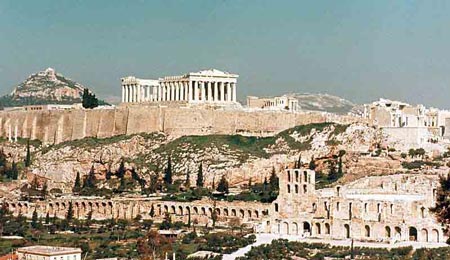
Effigy one: Acropolis Colina Athens Greece.
Wikimedia Commons
An impressive and endearing building information technology seems, along with the sunshine, to say Greece, but there is more to Ancient Greek art.
- Did y'all detect the statues, frescoes, vases and reliefs?
The Acropolis of Athens and its monuments are the symbols of the classical civilisation. It represents the thoughts and spirit of an ancient people. It's probably the greatest architectural and artistic circuitous of Greek Artifact.
Aboriginal Greece was a set of city-states with a common religion and civilization, but often competing with each other. The history of the Acropolis nosotros see today lies in the second half of the 5th century BCE. Athens had fought and won a war confronting the Persians. Following the war a democracy was established and Athens took the leading position amongst the other city-states in the ancient world. There was no sharp transition from one artistic period to another but some society can exist given by careful analysis of the styles of artefacts.
The Classical Greek period heralded an age in which thought and art flourished, and one in which an exceptional group of artists visualised in stone the aggressive plans of the Athenian statesman Pericles. Under the guidance of the sculptor Pheidias the rocky outcrop higher up the Athenian evidently was transformed into a unique monument.
The important monuments built at that time were (come across Figure ii):
- the Parthenon, built by Ictinus;
- the awe-inspiring entrance to the Acropolis known as the Erechtheon;
- the Propylaea, the monumental entrance to the Acropolis, designed by Mnesicles;
- and the minor temple, Athena Nike.
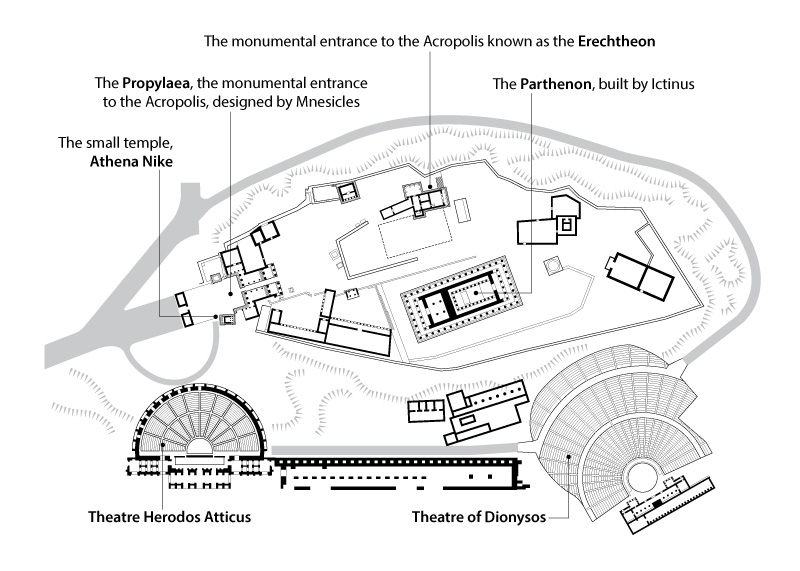
Figure ii: A plan of Acropolis Hill Athens, Greece.
Peter Bull
Where did all this classical art showtime?
It all started many years before the fifth century BCE. Its origins lie in the islands of Greece in the Cycladic and Minoan civilisation. As fourth dimension progressed the fine art of the region developed and eventually gave us the Western classical fine art. These forms are typified in the art styles of the Geometric, Archaic and Classical periods and the Hellenistic Periods.
Cycladic art - the product of mineral wealth
The Cyclades are islands that were, as we shall see, important to the Minoans and Mycenaeans and they make upward an archipelago of effectually 2200 islands, only simply around 33 of these are inhabited. For the ancients, they formed a circumvolve (Greek κύκλος / kyklos, hence their name) effectually the sacred island of Delos.
They are important considering they are located at the crossroads betwixt Europe and Asia, and the Near East and Africa. In antiquity the main travel routes were via the sea, simply navigation was not easy so they sailed along the coast keeping the land in view. The nearness of the islands and their natural resource fabricated them good places for settlement and trade every bit people migrated from Africa to Europe.
The area was settled from the Neolithic times and they experienced a cultural flowering in the 3rd millennium BCE. The Persians tried to take the islands during their attempts to conquer Hellenic republic, later which they entered into alliance with Athens in the Delian League. As a effect Delos became a keen commercial power.
The ancient Cycladic civilization, and its art, flourished from 3300-2000 BCE mainly due to the mineral wealth on the islands. The different art styles tin can be grouped into three Early Cycladic periods that are not strictly time dependent merely are expanse (see map 1) and time related:
- EC I (2800-2500 BCE) called the Grotta-Pelos Culture and best represented on the islands of Paros, Antiparos, and Amorgos;
- EC 2 (2500-2200 BCE) chosen the Keros-Syros Culture primarily seen on Syros;
- EC III (2200-2000 BCE) called the Phylakopi Culture, the fine art found on Milos.
From the map and the position of the islands we can see how the fine art has radiated out across the islands. One could hypothesis that the fine art moved and developed with the move of people can exist seen in Effigy 3. The shape of the human form has developed and in the final image is now stylised rather than being naturalistic.
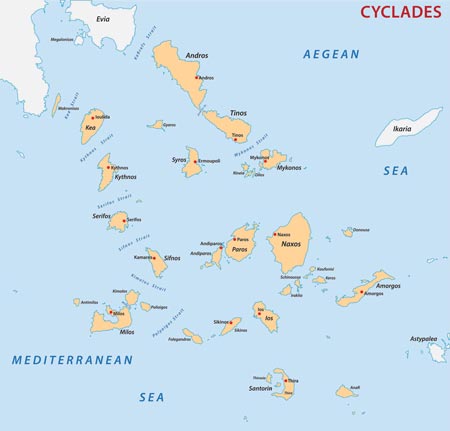
Map i: Map of Cyclides
Shutterstock / Rainer Lesniewski
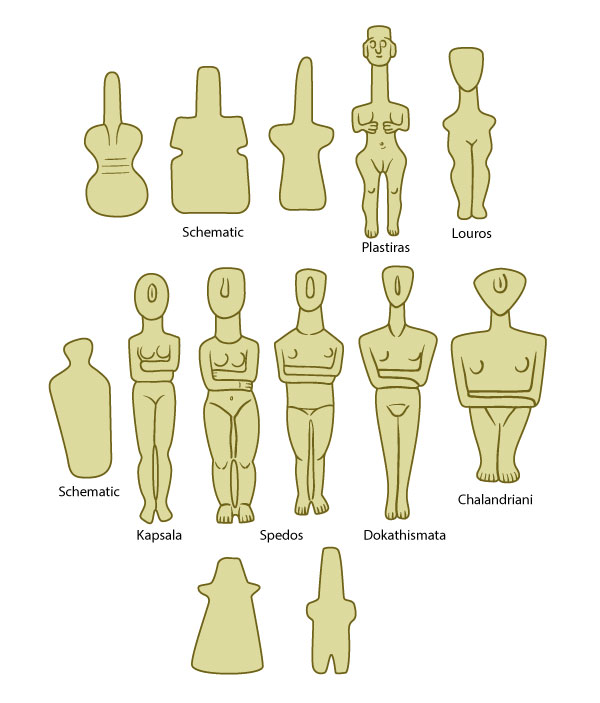
Figure three: Early cycladic figure types - Superlative : types of the Gotta-Pelos culture. Middle : types of the Keros-Syros culture. Bottom : types of the Phylakopi I civilisation.
Peter Balderdash
Because of the minerals on the islands, and the islanders' trade with other people, many of the island artists became specialists at using those materials. There is evidence of sculptors, potters, and metallic-workers with blacksmiths and foundries. One example of an important local cloth that influenced the art was obsidian, from the isle of Milos. This was the main material used for the production of tools, even after the development of metallurgy, considering information technology was inexpensive and very sharp and could be used to cutting and cleave marble. Statuary tools were also used to work marble, and have been found on Naxos and Paros. At that time marble was quarried in great quantities, while today it is mined.
The bronze tools were made using copper from Kythnos. Information technology naturally contained a lot of arsenic so the bronze was an arsenic copper blend. It was towards the end of the Cycladian civilisation that can was introduced to the islands. The oldest statuary tools containing tin were constitute at Kastri on Tinos. These take been dated to come from the Phylakopi Culture and analysis of their composition showed the tin came from Troad, an surface area in the Dardanelles, Turkey, virtually Troy. This indicated there was trade between the Troad and the Cyclades.
Naxos produced and however has quantities of an of import mineral called Emery, a dark granular rock used to make abrasive powder for grinding marble. Emery largely consists of the mineral corundum Al2O3 (aluminium oxide), mixed with other minerals including magnesium aluminate MgAl2O4 (a magnesium member of the spinel mineral family), hercynite FeAl2O4 (an iron member of the spinel family), magnetite Iron3O4 (some other atomic number 26 fellow member of the spinel family unit), and rutile TiOii (titanium dioxide). Titanium dioxide is still used today on emery paper and boards for grinding surfaces. To fine polish the marble the artists used pumice an igneous rock from the isle of Santorini.
The islands were rich in minerals that could exist used as pigments. There was azurite Cu3(CO3)2(OH)ii (a copper carbonate mineral) that gave a blue color, and haematite IroniiO3 (iron oxide) that gave a red colour. Both have been constitute on statuettes and in tombs encounter Figure four.
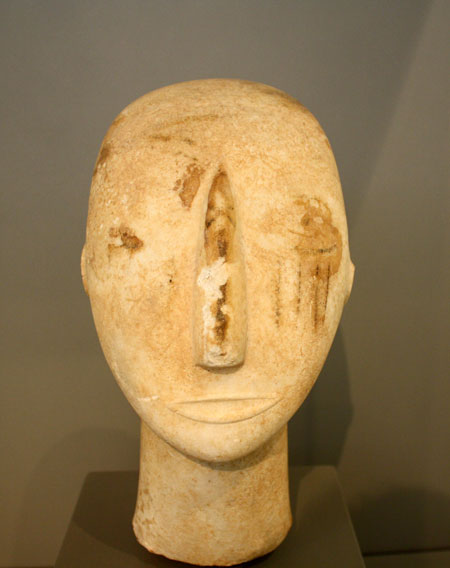
Figure 4: Cycladic Islands, Marble, (3200 - 2000 BC). Scratch or tattoos are sometimes plant on face and thought to exist a sign of mourning.
© World History Archive / Alamy
Cycladian fine art is best known for the stylised, female, nude marble sculptures. They are known equally figures or idols. The most famous are the musician forms such as the harp role player or piping player see Effigy 5.
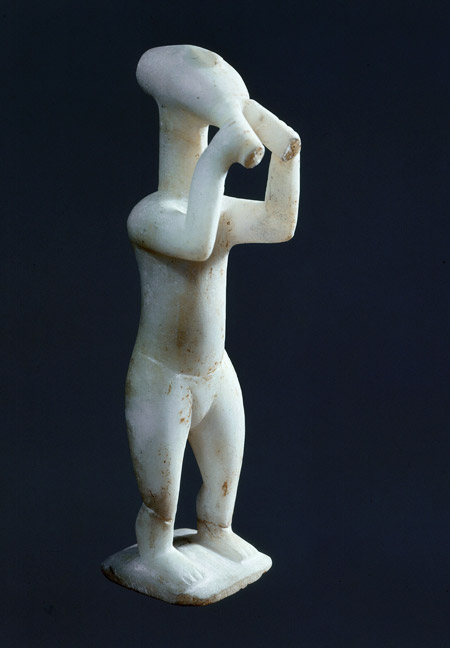
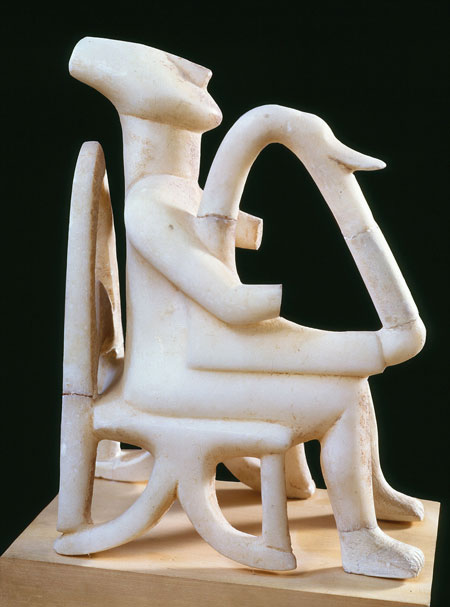
Figure 5: Harpist and double-flute histrion institute together in a single grave on Keros. 2700-2500 BC.
From http://www.ou.edu/finearts/art/ahi4913/aegeanhtml/cyscl4.html
Figure 5: Harpist and double-flute player found together in a single grave on Keros. 2700-2500 BC.
© The Art Archive / Alamy
Others depict a man with arms folded across the stomach. These date to 2500 BCE and course some of the earliest representations of musicians from the Greek world. They are typically flat and geometric which gives them a striking resemblance to today's modern art sculptures.
Many anthropologists believe they could be representations of a nature goddess in line with the theories of the Neolithic Venus of Willendorf, however not all archaeologists agree. There are many interpretations of their purpose from god idols to expiry images, and even to children'southward dolls. Archaeological prove suggests the images were regularly used in funerary do since almost have been plant in graves of both men and women. Some evidence signs of having been repaired, implying they were objects valued by the deceased and not fabricated specifically for burying. Larger figures were sometimes broken and so merely part of them was cached; a phenomenon for which in that location is no caption.
The local clay on the islands proved difficult for artists to work with. Therefore the pottery, plates and vases of this menses are rarely very good. Amongst the pottery institute on the island of Syros were some foreign objects known as 'frying pans', which most scholars believe were not used for cooking, simply every bit fertility charms or mirrors.
Minoan art from the celebration of life
The Minoan civilisation, an Aegean Bronze Historic period civilisation, arose on the isle of Crete. Flourishing from around the 27th century BCE to the 15th century BCE it was rediscovered at the outset of the 20th century through the work of British archaeologist Arthur Evans.
Minoan art tells of a people who were keen observers of their world, in touch with the environment and enjoying the world they lived in. The greatest collection of Minoan art is still on Crete in the museum at Heraklion, near Knossos.
Minoan art, with other remains, has been used by archaeologists to ascertain the three phases of Minoan culture. These are based on pottery styles and were created past Evans and modified by later archaeologists. They divide the Minoan period into three main eras:
- Early Minoan (EM) 3650-2160 BCE
- Middle Minoan (MM) 2160-1600 BCE
- Late Minoan (LM) 1600-1170 BCE.
Woods and textiles from this time have been lost through decomposition, and then the best preserved Minoan fine art forms are the palace architecture with frescos that include landscapes, pottery, stone carvings and intricately carved seal stones. Not much fine art has survived from the Early Minoan (EM) period. What has been found, in sites throughout the island of Crete? Are Cycladic statuettes and pottery fragments indicating merchandise across the Aegean islands?
The climax of Minoan art was reached during the Centre Minoan (MM) flow reflecting a time of boggling development, while the fine art of the Later Minoan (LM) period echoes the decline of the Minoan civilization.
Ceramics have been used as a dating method by archaeologists because of their feature designs. In the EM period the ceramics were characterised by linear and geometric patterns such as spirals, triangles, curved lines, crosses and fishbone motifs. This elementary way developed in the MM menses into representative natural designs, such equally fish, squid, birds and lilies. In the LM catamenia the flowers and animals were still present simply in greater multifariousness.
Minoan frescoes
At the cease of the EM period nosotros run into the appearance of palaces, specially around Knossos. On the walls of the palaces were frescoes; some of the only paintings to remain from the period today. The palace frescoes are characterised by geometric simplification of natural shapes and monochromatic paintings. Frescoes were the main class of Minoan art during the EM period. Along with decorated pottery, they are often the only tape of just how the earth appeared to the Minoans and betwixt them they give u.s.a. some tantalising glimpses of their beliefs, cultural practices and aesthetic tastes.
The early on Minoan frescoes are limited to simple monochrome walls, frequently red sometimes black. As the Minoans improved their techniques and quality of plaster and pigments, the fashion began to change with possible influence from Egypt and the Near Due east.
Minoan paintings display Egyptian influences in the mode of the figures. They are painted with a frontal style and the figures are outlined so painted. Yet it is by no ways a direct copy of Egyptian style since the figures have a distinctly Minoan style. In fact the Minoan style influenced other culture'south fresco painting. The small waist, fluidity of line, and vitality of character is bestowed on every painted figure and the Minoan style conventions emphasised elasticity, spontaneity, and dynamic move. The colours and high-contrast patterns give the characters and nature scenes an elegant freshness.
The developing style used natural subjects. This included flowers such as lilies, irises, crocuses and roses, and plants such equally ivy and reeds. The Minoans were one of the primeval cultures to paint natural landscapes without humans nowadays in the scene.
Animals were also common; monkeys, birds, cats, goats, deer, bounding main urchins, dolphins and fish, many oftentimes in their natural habitat. Minoan frescoes were oft framed with decorative borders of geometric designs but the primary fresco itself could extend beyond the conventional boundaries to cover several walls creating a panorama.
Dry and moisture frescoes
The "dry-fresco" (fresco secco) technique involves the awarding of paint, in particular for details, onto dry plaster. The "true" or "moisture" painting method (buon fresco), on the other manus, involves painting on moisture plaster so that the pigments are absorbed and bind well to the wall plaster. This fixes the painting and stops it from fading.
Egyptian painters painted their walls in the fresco secco technique but the Minoans used the buon fresco method. The difficulty with the buon fresco method was it required authentic and quick execution, only information technology had the reward of assuasive for a high degree of improvisation and spontaneity. Because the artists had to piece of work inside strict time constraints they had to be skilful. Their brush strokes needed to be fluid and graceful, and still the chance in the art produced excitement. It is probably that which characterises Minoan painting and makes the wet method of painting the most appropriate run into Effigy 6.
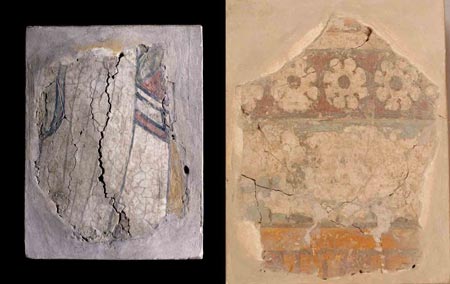
Effigy 6: Fragments of Minoan fresco paintings from 1450–1375 BCE (LM II)
© The Trustees of the British Museum
Low relief was used in the plaster to give a shallow three-dimensional result. No surviving examples of shading furnishings have been constitute in Minoan frescoes, although the colour of the groundwork changes whilst the foreground subjects remain unchanged. Some of the Egyptian colour conventions were adopted by the Minoans: male person skin is usually ruddy, female skin white, and the metal gold is xanthous, silverish is blue and bronze is red. Fresco was also used on walls to imitate architectural features, such as veined alabaster slabs painted on the lower portions of walls.
Pigments used for the colours were:
- black - carbonaceous shale;
- cherry - haematite (iron oxide IroniiO3);
- white - hydrate of lime (calcium oxide Ca(OH)2);
- yellow ochre - goethite (iron oxyhydroxide FeO(OH));
- blue - Egyptian Blueish (copper silicate CaCuSi4O10);
- and greenish - blue and xanthous mixed.
Frescoes are inherently fragile and oft take been painted by anonymous artists. The ravages of fourth dimension ofttimes leave them incomplete and archaeology can leave them removed from their original environs. This can make interpretation and dating hard, and has lead to some restoration being more imaginative than accurate.
Columns and gemstones
Within the palaces some other characteristic was common; the Minoan column. It is wider at the acme than the bottom, and is called an 'inverted' cavalcade because nigh Greek columns are wider at the bottom creating an illusion of greater height. These Minoan columns were made of wood, generally painted cherry-red, mounted on a simple stone base and topped with a pillow-like, circular piece equally a capital.
Some Minoan artisans worked with gemstones to create seal stones. They have been institute in large quantities at Knossos, Mallia and Phaistos. These are amulets nigh 3cm (in bore?) but some have been constitute that are larger.
Mycenaean Greece
The Mycenaean Menstruum was from around 1600 to 1100 BCE. Mycenaean Greece takes its proper noun from the Bronze Historic period archaeological site of Mycenae in Argolis, Peloponnese, on the mainland of southern Greece. Mycenaean settlements have too been institute in other parts of Greece including Epirus, Republic of macedonia, on islands in the Aegean Sea, and on the coasts of Turkey, Republic of cyprus and Italia.
Mycenaean Greece flourished under influences from Minoan Crete and the Cyclades during the Late Helladic (LH) period (1550-1060 BCE). Late Helladic pottery typically stored such goods as olive oil and wine, and the potters sometimes inscribed their work in Linear B, a syllabic script recognisable equally a class of Greek. The LH menstruum is divided into I, II, and III. LH I and Ii overlap with Late Minoan (LM) ware and III overtakes it. LH III is further subdivided into IIIA, IIIB and IIIC.
Pottery has been used as a dating tool because the Mycenaean people were corking potters and made a smashing deal of pottery in many unlike styles. Archaeologists have found a number of widely various sizes and styles. They have found stirrup jars, pitchers, kraters and chalices known every bit 'champagne coupes' because of their shape. They produced pottery in great numbers and then they exported large quantities of luxurious pots featuring heavily worked painted decorations incorporating mythic, warrior or creature motifs.
Mycenaean metal-workers commonly worked in statuary and made tripods, basins and lamps.
The painting of the Mycenaean age was influenced by the Minoans. Fragments of wall paintings have been found in or around the palaces at Pylos, Mycenae and Tiryns, and in some domestic contexts. The largest complete wall painting depicts three female figures, probably goddesses, in the and then-chosen Cult Centre at Mycenae. It shows hunting, bull leaping, boxing scenes and processions. Other frescoes include geometric or stylised motifs, also used on painted pottery encounter Figure 7.
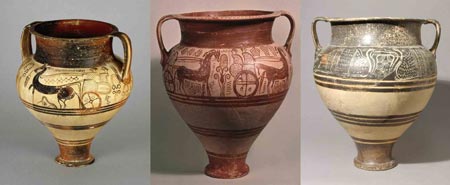
Effigy 7: Mycenaean Pottery from 1400–1350 BCE (LNIIIaI)
© The Trustees of the British Museum
Archaic Menses
The Primitive period was between 800 BCE and 480 BCE. It saw the rise of the city-states (polis), the founding of colonies and the blooming of classical philosophy, theatre and poetry, which appeared with the reintroduction of the written language, lost during the Greek Nighttime Ages.
The term archaic takes its name from what, in art history, was considered the old-fashioned way of sculpture and other forms of art and craft characteristic of that time, as opposed to the more natural look of work in the following Classical menstruation. During this menstruation a massive import of raw materials including metals, and a new mobility amongst craftsmen, acquired new craft skills to exist introduced in Hellenic republic.
The following three periods take been identified:
- Early Archaic (660-580 BCE)
- Mid Archaic (580-535 BCE)
- Late Primitive (540-480 BCE).
The Archaic menstruation is famous for its sculptures, both gratuitous-standing and in relief, used to adorn temples and funerary monuments. These were made from limestone, marble, terracotta, wood, bronze and rarer metals. During the Early Archaic period the major sculptural forms were the kouros (free-standing ancient Greek sculptures which offset announced in the Archaic period in Greece they are life sized and represent nude male youths), and its female equivalent is the kore.
Archaic pottery
Likewise mutual in the Archaic menstruation was pottery made for everyday use, and every bit the trophies won at games. It developed the orientalising style (marked by floral and animal motifs), signalling a shift away from the geometric style of the before Nighttime Ages, and the accumulation of influences from Phoenicia and Syria.
The styles associated with the after part of the Archaic period are black-figure pottery originating from Corinth during the 7th century BCE. The later styles were known equally the cherry-red-figure way, developed by the Andokides painter. He was an aboriginal Athenian vase painter named subsequently Andokides, the potter for whom he worked actively from 530 to approximately 515 BCE. His work is unsigned and typified past the Egyptian-like 'left foot forward', the 'archaic smile', and the very patterned and conventionalised hair, or 'helmet hair'. Greek pottery is oft signed, sometimes by the potter or master of the pottery, but only occasionally by the painter see Effigy 8.
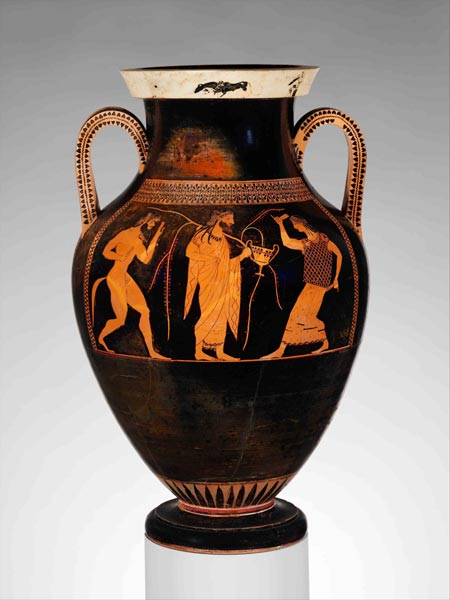
Effigy eight: Bilingual amphora by the
Andokides Painter, c520 BCE (Munich)
Effigy viii: Bilingual amphora by the Andokides Painter, c525 BCE (Munich)
The Metropolitan Museum of Art, www.metmuseum.org
By the afterwards Archaic and early Classical menstruum, however, the two keen commercial powers, Corinth and Athens, had come to boss the culture and merchandise. Their pottery was exported all over the Greek world, driving out local varieties and going as far afield as Spain, Ukraine and Italy. Many of these pots were mass-produced products of low quality. By the 5th century BCE, pottery had go an industry and pottery painting ceased to be an important art form.
Colour and decoration
During the Primitive menstruation the range of colours used on pots was restricted past the engineering science of firing: black, white, cerise, and yellow were the nearly common. In the iii before periods, the pots were left their natural low-cal colour, and were decorated with slip that turned black in the kiln.
In later periods, equally the aesthetic shifted and the technical proficiency of potters improved, decorations took the form of human figures, usually representing the gods or the heroes of Greek history and mythology. Battle and hunting scenes were besides popular, since they allowed the depiction of the horse, which the Greeks held in high esteem. In afterwards periods erotic themes, both heterosexual and homosexual, became common.
Classical Menses (510-323BCE)
The Classical Period was a 200 twelvemonth period in Greek culture. In the Classical period there was a revolution in Greek statuary, usually associated with the introduction of commonwealth changes in the style and function of sculpture. Poses became more naturalistic. The technical skill of Greek sculptors in depicting the human being class in a variety of poses greatly increased and from nearly 500 BCE the statues began to depict existent people.
The not bad temples of the Classical era such equally the Parthenon in Athens, and the Temple of Zeus at Olympia were built. These required relief sculpture for decorative friezes, and sculpture in the round to make full the triangular fields of the pediments and so sculptures and statues were put to wider uses presenting aesthetic and technical claiming which stimulated much sculptural innovation. Unfortunately these works survive just in fragments, the most famous of which are the Parthenon Marbles, one-half of which are in the British Museum.
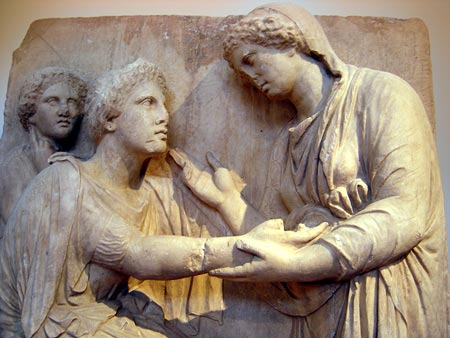
Figure 9: Family group on a grave marker from Athens
Prototype Courtesy of Ricardo André Frantz / Wikipedia, CC BY-SA 3.0
Funeral statuary evolved during the Classical menstruum and highly personal family groups of the Classical period began to be seen. These monuments are commonly found in the outskirts of Athens, which in ancient times were cemeteries. Some of depict "ideal" people the mourning mothers, the dutiful sons, but every bit fourth dimension went on they increasingly depicted real people, typically showing the departed taking his dignified exit from his family. They are among the nearly intimate and affecting remains of the Ancient Greeks see Figure 9.
Hellenistic fine art
The Hellenistic period dates from the death of Alexander the Great in 323 BCE to the emergence of ancient Rome, marked by the Battle of Actium in 31 BCE and the subsequent conquest of Ptolemaic Egypt in 30 BCE. In the Archaic and Classical art, the sculptures were generally static and idealised the archaic sculptures showed no or little emotion the Classical began to show some emotion. Classical architecture was 'perfectly' modelled and highly organized. Notwithstanding the Hellenistic sculptures became more active, dynamic, and realistic displaying a wider range of emotion. Hellenistic architecture became more than grandiose and ornamented.
Frescoes
Few examples of Greek wall paintings from the Hellenistic catamenia have survived only it was very influential on the Roman frescoes, for example those of Pompeii or Herculaneum. The few examples that survive are in archaeological discoveries at Alexandria. Here six funerary stele (a rock or wooden slab, generally taller than information technology is broad, erected every bit a monument), in what is known as The Soldier'due south Tomb, are exceptionally well preserved Greek paintings from the Ptolemaic catamenia of the 4th and 3rd centuries BCE.
More recently plant examples of Greek wall paintings tin be seen at the cemetery of Pagasae close to modern Volos, at Vergina in the quondam kingdom of Macedonia which are Classical in style, or those at Paestum which are really Lucanian since the Lucanians conquered and occupied Paestum, but Greek culture continued to survive and fifty-fifty flourish so the painting are often grouped as Greek in influence.
One of the all-time preserved frescoes is at the Tomb of the Diver at Paestum. Discovered in 1968 at the Tempa del Prete necropolis on the southern limits of Paestum, information technology is a cute example of Greek tomb painting and possibly the only complete Greek wall painting. The tomb is made of v limestone blocks, all from a local source. It shows a symposium (drinking group) or banquet scene extending over four stone slabs that brand up the walls of the tomb and on the hat slab is a young human being diving see Effigy 10 & 11. It is after this image that the tomb is known. It is dated to 480 – 470 BCE.
The paintings are fresco style. Plaster was applied to the stone, and the chief features were outlined using a pointed tool (stylus) and coloured scarlet while the plaster was however fresh. The colours used were black, varying shades of blood-red, blue, green and white. Once the flesh tones had been painted onto the rock the anatomical outline was painted in black to pick out the human shape.
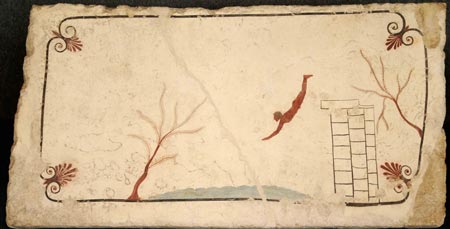
Figure 10: The lid of the Tomb of the Diver Paestum
© charistoone-images / Alamy
The fine art of the Tomb of the Diver is substantially Greek in character with some Etruscan influences only is a good example of the blazon and form of art at this time of Classical Hellenic republic.
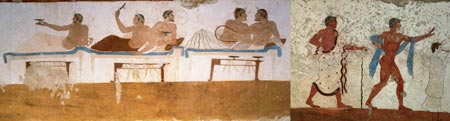
Figure xi: Symposium or banquet scene on the north wall Cortege of guests on the westward wall
© PRISMA ARCHIVO / Alamy and © VPC Travel Photo / Alamy
Mosaics
It appears that during the time of the Ancient Greeks the mosaic developed. In fact they are responsible for the invention of tessellated mosaics (the tiling of a flat flooring or wall using one or more geometric shapes, called tiles, with no overlaps and no gaps). The largest numbers of early types of mosaics seem to be from fine pavements from the mid-2d century onwards.
The earliest known examples of mosaics made of different materials were institute at a temple building in Abra, Mesopotamia, and are dated to the second half of 3rd millennium BCE. They consist of pieces of coloured stones, shells and ivory. Despite there being some simple examples of tessellation in some 3rd century BCE mosaics information technology is not known how or where and when innovation took place.
Mosaic piece of work started with pebbles such every bit those at Pella see Figure 12a and went on to the highly refined forms such as those establish at Pergamum and Alexandria see Figure 12b. It was also from about this time that the mosaic found its manner into the private home as a form of ornament and this is institute all the way from the edges of Republic of india beyond to Spain.
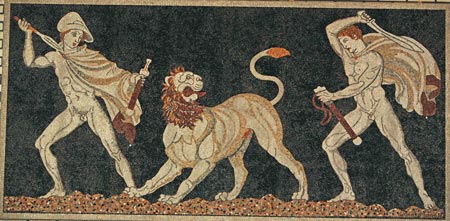
Figure 12a: Pebble mosaic at Pella Abduction of Helen by Theseus
© QEDimages / Alamy
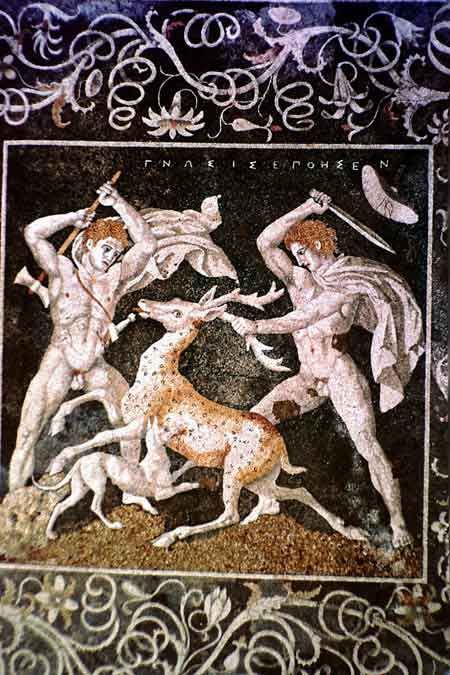
Figure 12b: Greek mosaic, a deer chase, Signed "Gnosis created"
© Image Asset Direction Ltd. / Alamy
Pottery
Perhaps the near well-known art grade from the Greek menstruation is the painted and relief style pottery. On some of the pots and vases the painting was practical after firing since the pigments used for painting were unstable at loftier temperatures and because of this fragility they were frequently used for funerary pots. The best forms of this style have been found at Centuripe in Sicily, where a workshop was active until the 3rd century BCE.
The more well-known ruddy and black pottery comes from the period betwixt sixth to quaternary centuries BCE and used in Athens every bit valuable pottery. Everyday ware was plain, simple, fired red clay. In the forming of both fine valuable and plain pottery the potter used a wheel to plough and shape the pot, and with big pots this was washed in sections which were then assembled into the whole pot later sunday drying and before firing. The slip was applied leaving the shapes in red and when fired the slip would turn black.
Firing
The firing process of both cherry-red and black vessels was a single phase but consisted of three stages:
The first phase was fabricated with all the vents open allowing oxidation to take identify. Air was immune into the kiln turning the whole vase the colour of the dirt. The heat and oxygen turned both the pot and slip a blood-red-brown due to the formation of haematite (FeiiOthree) in both the paint and the dirt torso.
In the second stage the air vents were partially closed so the oxygen content was reduced. Green wood was introduced to the kiln, which caused the object to plough black in the smoky environs. These conditions created carbon monoxide, which turned the red haematite to black magnetite (Fe3Oiv), and the temperature decreased due to incomplete combustion. In the second phase, the chemical composition of the slip surface is altered and cannot be oxidised so information technology remains black. This process known as the 'iron reduction technique' produced a striking black surface with a metal sheen.
In the last, third stage, air was let back into the kiln causing the reserved portions to turn orange while the glazed areas remained blackness. The skid was thought to be a fine interruption (colloid) of illitic clay with very low calcium oxide content and rich in fe oxides and hydroxides, making this surface different from the clay used for the body of the vase.
Sculpture
The other fine art grade the Greeks are famous for is the sculptured statue. Over the centuries the sculptures became more realistic, less austere and often showing emotion. The form is still dominated by the naked male person, particularly the athlete, but over the Hellenistic menses there is a greater diversity of subjects, poses and an interest in individuals such as rulers, philosophers, generals, politicians, orators and poets as well every bit the common people.
Hellenistic sculpture is identified past the 'perfect' sculpture. This allowed the statue to be viewed from all angles. To fabricate the sculpture the artist had to study draping, the effects of transparency of article of clothing, expression and character of the subject field to create atmosphere. The creative person explores themes such equally suffering, sleep or quondam age and statues begin to appear in groups both mythological and historical. Pergamum becomes the place for statues and the piece of work found there is frequently called Hellenistic Baroque.
The Elgin marbles
Examples of the Hellenistic style tin can be seen in the range of statues from this period on display at the British Museum, London. The Elgin Room contains the Parthenon marbles; pieces of sculptures removed from the Parthenon by Thomas Bruce, Earl of Elgin during 1801-05 come across Figure 13.

Figure 13: Riders from the pediment of the Parthenon from the Elgin Room
From the British Museum, © The Trustees of the British Museum
Figure xiii: Riders from the pediment of the Parthenon from the Elgin Room
© The Trustees of the British Museum
Congenital nearly 2500 years ago the Parthenon was a temple dedicated to the Greek goddess Athena. For a thousand years it was the church of the Virgin Mary of the Athenians, a mosque. Now it is an archaeological ruin undergoing restoration. The sculptures have been damaged over the class of the centuries peculiarly when the urban center was under siege by the Venetians in 1687. The Parthenon itself was existence used as a gunpowder store when a huge explosion blew the roof off and destroyed a big portion of the remaining sculptures. The building has been a ruin ever since.
By 1800 but almost half of the original sculptural ornament remained and so Lord Elgin, the British ambassador to the Ottoman Empire, (Athens had been part of the Ottoman Empire for nearly 350 years), decided to remove half of the remaining sculptures. He acted with the full cognition and permission of the Ottoman government. Being passionate nigh ancient Greek fine art he transported the sculptures back to Britain. The arrival of the sculptures in London regenerated interest in Ancient Greek civilisation and influenced contemporary artistic trends.
In 1816 many of the sculptures were obtained by the British Museum and since and then take been on display to the public. Others were taken to Musée du Louvre, Paris, Vatican Museums, National Museum, Copenhagen, Kunsthistorisches Museum, Vienna, University Museum, Würzburg and the Glyptothek, Munich.
Painted marble
The pieces shown above were sculptured past Phidias and decorated the top of the Parthenon. They were meant to be seen from a altitude and to assist this they had been coloured.
More work on other Greek statues shows that many of them were painted equally were the temples that housed them. Fourth dimension and weather have stripped most of the hues away and then, as they were excavated from the soil or fished out of the sea, the statues appeared equally white marble. So, since the Renaissance, the accepted colour for sculptures has been white in view of the perceived ancient aesthetic. In fact in some farthermost situations restorers scrubbed off whatsoever pigment found on the statue.
Websites
http://www.smithsonianmag.com/arts-culture/truthful-colors.html?c=y&page=2
Source: https://edu.rsc.org/resources/ancient-greek-art/1636.article
0 Response to "The Dawn of Greek Art From Homer to the Persian Wars Athens Paros Naxos"
Post a Comment